During the beginning of the semester, I went and walked through one of my favourite exhibitions of all time (besides the 2014 Biennale). Tatsuo Miyajima, at the MCA, Sydney.
Tatsuo’s Miyajimas: Connect with Everything featured at the Museum of Contemporary Art, Sydney is Miyajima first solo exhibition in the southern hemisphere. Held as part of the Sydney International Art Series from November – March 2017, the exhibition is a large-scale walk through of light and mixed media installations.
Connect with Everything is an exploration of the political issues of war, poverty, death and environmentalism through contemporary art. The exhibition highlights Miyajima’s interest in exploring the concept of numbers, Buddhist principles of life and death. In Mega Death audiences are surrounded by sensory experiences in a room scale installation of light and colour. Repetitive white LED cubes are mounted against the wall in patterns of 1-9, against an immersive neon blue glow.
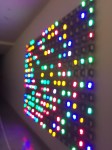
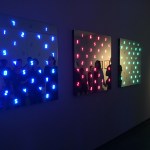
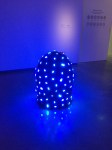
While the use of LED light is prolific in art and design, Miyajima’s uniqueness in practice comes from his customisation of his own digitial ‘counters’ or ‘cubes’. Miyajima created his own customised digital ‘counters’ in late 1990’s. Using LED technology, Miyajima’s medium is intrinsic to his work today, having developed from red and green to a greater variety of colours such as blue and white, as LED technology became more globalised.
Here, Miyajima uses the theme of counting and numeracy as a metaphor for issues in the lives of the viewer. The repeated counters numbered from one to nine, signify the different stages of life. By turning on and off according Miyajima symbolizes the Buddhist principles of existence and rebirth.


As the counters continue to turn ‘off’, every so often, Miyajima simultaneously omits the use of the number ‘zero’ from his work. He compares his process of counting, as reflective of “counting towards death, which zero represents” The audience is forced to sit still, blanketed in darkness as they observe their place within the gallery space, and wait or ‘count down’ for the lights or the metaphorical ‘zero’.
in Time Train to Holocaust and Counter Coal. Mijuma used LED, IC, electric wire, coal, mdf, HO rail, and Fleischmann 4117 HO Scale steam locomotive toy train. Counter Coal features a large mass of coal interspersed with red LED lights. Audiences stand observing, as the artwork Time Train to Holocaust, a small, automatic train system borders it. In these works Miyajima explores the socio political concerns of war and poverty, specifically WWII, by referring to the train system used in Nazi Germany during WWII to transport individuals to concentration camps.
Miyajima explains the concept of the ongoing train as “a critique of all the killing that happened over the twentieth century” as well commenting on it being a continuing trend even in the future. (Miyajima, 1992)
While the subject matter and medium are initially indistinguishable, the ambiguity directs the audience towards the artist’s statement, furthering Miyajima’s message even more.


Originally pursuing a degree at Tokyo Arts University in 1980, Miyajima’s practice emerged after his suffering from bouts of depression, as he used art to “communicate to people”. (Miyajima, 1992)
After developing an interest in themes nature and artificiality, his practice progressed from performance art in the streets of Tokyo to oil paintings ultimately to exploring electronics after noticing the gadgets on the sidewalk shops, which were highly prevalent in his small town of Akhihabara. Miyajima explains this progression, due to his “interest between things” (Miyajima1992) and his desire to have no single fixed focal point in his art.
From here, the medium of electronics developed into the foundation for Miiyajimas process. This is heavily shown in Life (Rhizome) no. 3 2012.
Using crisscrossed diagonal wires wall mounted to a metal frame, Miyajima creates a buzzing electrical grid of brightly coloured LED lights.
Influenced by the performance based political work of Bueyes, such as I like America and America like Me, Rhizome no 3 pays homage to performance art by being a self performing artwork, while still moving away enough from the form to be a permanent, tangible artwork.
Overall Miyajima’s work exemplifies the importance of the aesthetic. His interactive and vividly eye catching pieces, proved to be thought provoking and entertaining, as it gained a wide versatile audience.


Discover more from Luna
Subscribe to get the latest posts sent to your email.
 Luna
Luna 